
H2S Corrosion in Wastewater Infrastructure: How to Protect Critical Assets
Wastewater infrastructure is built to handle demanding environments, but some of the most damaging threats are not always visible at first glance. One of the most common and destructive challenges in sewer systems is hydrogen sulfide (H2S) corrosion.
For municipalities, engineers, utility managers, and contractors, understanding H2S corrosion is essential to protecting critical assets, reducing emergency repairs, and extending the service life of wastewater systems. Hydrogen sulfide has been proven to cause severe concrete and steel deterioration, structural loss, safety concerns, and costly rehabilitation.
The good news is that when H2S corrosion is identified early and addressed with the right rehabilitation strategy, communities can restore and protect aging infrastructure without relying on disruptive excavation or full replacement.
What Is H2S?
H2S is a colorless gas commonly found in wastewater collection and treatment systems. It is often recognized by its strong “rotten egg” odor, but its impact extends far beyond smell.
In sewer environments, hydrogen sulfide forms when organic matter breaks down under low-oxygen conditions. This often occurs in areas where wastewater flow is slow, turbulent, stagnant, or exposed to long retention times. Common locations include the headspace of manholes, wet wells, lift stations, pipes, and treatment structures.
Once hydrogen sulfide gas is released into the airspace of a sewer structure, the biogenic corrosion process begins on exposed surfaces where moisture and sulfur-oxidizing bacteria are present. Those bacteria consume the H2S gas and produce sulfuric acid as a byproduct, meaning that when H2S is present, acid formation is likely occurring to varying degrees across the structure. Over time, sulfuric acid attacks concrete, mortar, steel, and other infrastructure materials.
How H2S Corrosion Damages Wastewater Infrastructure
H2S corrosion is especially damaging because it can move beyond surface deterioration and adversely impact the structural integrity of wastewater assets.
For concrete structures, H2S corrosion can lead to:
- Surface softening
- Loss of cementitious paste
- Exposed aggregate
- Exposed reinforcement
- Cracking or spalling
- Reduced wall thickness
- Infiltration and inflow concerns
- Eventual structural compromise
What may begin as a surface-level corrosion issue can quickly become a larger infrastructure problem. Once the substrate begins to deteriorate, the asset becomes more vulnerable to additional chemical attack, groundwater intrusion, and long-term structural damage.
Why Wastewater Systems Are Especially Vulnerable
Wastewater environments create ideal conditions for H2S corrosion, also known as microbiologically induced corrosion, or MIC. These systems often include moisture, bacteria, fluctuating flows, confined spaces, organic material, and anaerobic conditions. Together, those factors create a harsh environment where microbial-induced corrosion can develop and accelerate.
Common assets affected by H2S corrosion include:
- Manholes
- Lift stations
- Wet wells
- Grit chambers, influent channels, and other headworks structures
- Junction boxes
- Pipelines, especially in pipes not flowing full
- Digesters
- Tanks
- Tunnels
Because many of these structures are difficult to access, inspect, or take offline, corrosion can progress quietly before it becomes a visible or urgent problem.
Why H2S Corrosion Is More Than a Maintenance Issue
For many municipalities and utilities, corrosion may initially seem like a maintenance concern. However, H2S corrosion can quickly become a capital planning issue, a public safety issue, and an operational issue.
When wastewater assets deteriorate, communities may face:
- Increased emergency repair costs
- More frequent maintenance needs
- Odor complaints
- Service disruptions
- Infiltration and inflow concerns
- Reduced system capacity
- Safety risks for crews
- Shortened asset life
- Higher long-term replacement costs
The longer H2S corrosion is left untreated, the more expensive and disruptive the solution can become. A structure that could have been rehabilitated with a protective lining may eventually require full replacement if deterioration progresses too far.
That is why proactive inspection, planning, and rehabilitation are critical.
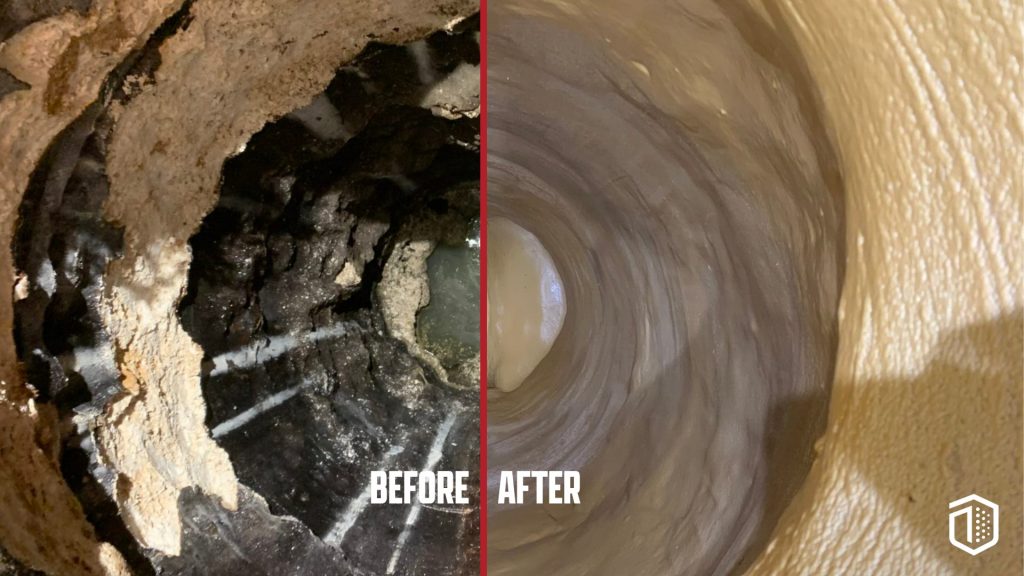
Signs of H2S Corrosion in Wastewater Assets
H2S corrosion is not always obvious from the surface, but there are warning signs asset owners and inspection teams can look for.
Common signs include:
- Rough or softened concrete surfaces
- Exposed aggregate
- Flaking, cracking, or spalling concrete
- Visible crown corrosion in pipes
- Deterioration above the flow line
- Moisture, staining, or active infiltration
- Loss of wall thickness
- Repeated coating failures
- Structural defects in manholes, wet wells, or lift stations
Because corrosion often occurs in confined or difficult-to-access environments, proper inspection and documentation are essential. Identifying the severity of the damage helps determine whether a structure needs corrosion protection, structural rehabilitation, or a combination of both.
How Protective Linings Help Combat H2S Corrosion
Protective linings create a barrier between the corrosive wastewater environment and the underlying structure. In trenchless rehabilitation, spray-applied lining systems can be used to restore and protect existing assets without removing and replacing the entire structure.
For wastewater applications, a lining must be able to withstand harsh chemical exposure, moisture, abrasion, and operational demands. Depending on the asset and project conditions, the lining may also need to provide structural reinforcement.
Sprayroq’s product line includes solutions designed for municipal wastewater treatment and sanitary sewer environments. These systems are used to help protect critical infrastructure from corrosion, infiltration, and long-term deterioration while minimizing the disruption associated with traditional excavation and replacement.
When Structural Rehabilitation Is Needed
In some cases, corrosion protection alone is not enough. If a structure has already experienced significant section loss, cracking, deformation, or substrate deterioration, it may require a structural rehabilitation approach.
Structural rehabilitation is designed not only to protect the asset from future corrosion, but also to restore strength and extend service life. For example, SprayWall is a spray-applied polyurethane lining designed to reinstate structural integrity while providing infiltration control, chemical resistance, and corrosion resistance.
This matters because wastewater assets are not just surfaces to be coated. They are critical pieces of infrastructure that must continue to perform under load, flow, pressure, and environmental stress.
Why Surface Preparation Matters
Even the best lining system depends on proper surface preparation. Before a protective or structural lining is applied, the existing substrate must be evaluated and prepared based on project conditions.
This may include cleaning the surface, removing deteriorated material, stopping active infiltration, drying the structure, repairing defects, and ensuring the substrate is ready for application.
At Sprayroq, we always emphasize the importance of starting with a clean, dry surface and using a manufacturer-trained applicator team that can address real-world rehabilitation conditions. Our applicators are thoroughly trained on surface preparation requirements, including how to identify and address conditions that could impact adhesion or lining performance. Proper preparation helps support consistent application, strong adhesion, and long-term lining performance.
The Cost of Waiting
Delaying rehabilitation can make H2S corrosion more expensive to address. As corrosion progresses, the asset may require more extensive surface repair, increased lining thickness, bypass pumping, emergency response, or even replacement.
Proactive rehabilitation can help communities:
- Extend the life of existing assets
- Reduce excavation and replacement costs
- Minimize traffic and service disruption
- Improve long-term system reliability
- Protect capital budgets
- Reduce unplanned repairs
- Preserve critical wastewater infrastructure
For municipalities managing aging infrastructure, the goal is not only to repair what has already failed. The goal is to protect assets before corrosion creates larger operational and financial challenges.
Protecting Wastewater Infrastructure from H2S Corrosion
H2S corrosion is one of the most persistent threats in wastewater infrastructure, but it can be managed with proactive inspection, proper planning, and the right rehabilitation strategy.
By understanding how hydrogen sulfide forms, how it contributes to sulfuric acid degradation, and how protective linings help defend against corrosive environments, asset owners can make more informed rehabilitation decisions.
Spray-applied polyurethane lining systems offer a trenchless way to restore and protect wastewater assets while reducing the disruption associated with traditional replacement methods. For structures impacted by corrosion, infiltration, or structural deterioration, the right lining solution can help extend service life and improve long-term system performance.
Hydrogen sulfide corrosion may start quietly, but its impact can be significant. From manholes and lift stations to wet wells and treatment structures, H2S corrosion can weaken critical wastewater assets, increase maintenance costs, and shorten infrastructure life.
Contact Sprayroq today to learn how our trenchless rehabilitation solutions can help protect your wastewater infrastructure from corrosion, structural deterioration, and long-term asset failure.